
Chillers and liquid chillers
Eco-friendly chillers
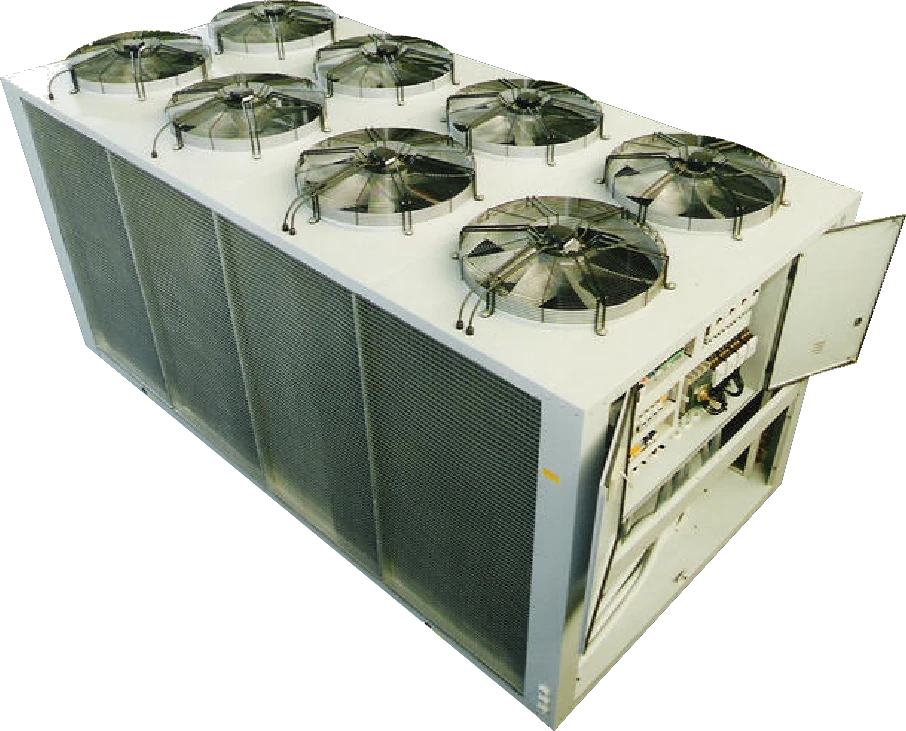
Chillers with low-GWP refrigerants, designed to current environmental regulations or the refrigerant your company specifies.
Applications
What it solves.
The Montreal Protocol, through the Kigali Amendment, phases down HFCs with high global warming potential (GWP) step by step. We design each eco-friendly chiller with the refrigerant that meets the country's regulations, your company's environmental policy or the GWP limit you set, and we adapt the unit to its safety class.
- New units that must meet a GWP limit or a corporate environmental policy.
- Plants replacing chillers that run on R-22, R-404A, R-410A or R-134a.
- Projects for multinationals and exporters with emission-reduction targets.
Configurations
A configuration tailored to your application.
Technical selection defines the equipment and its integration with the process.
Natural refrigerants
Ammonia, CO₂ and hydrocarbons: zero or near-zero GWP and outside the Kigali phase-down. Each one calls for a design suited to its safety class: toxicity for ammonia, pressure for CO₂ and flammability for hydrocarbons. We cover them in detail under Green chillers.
HFOs and low-GWP blends
R-1234ze(E), R-513A, R-515B, R-454B, R-454C and R-455A, among others. They replace traditional HFCs with fewer changes to the unit; some are mildly flammable (class A2L) and need suitable components and ventilation.
Designed to the regulation or your specification
We start from the GWP limit or refrigerant required by regulation or by your company, and select compressors, heat exchangers, valves and control panel for that fluid. If the refrigerant changes, we review the safety of the installation site.
Technical data
Reference values.
Refrigerants in the eco-friendly line
100-year global warming potential (GWP) and ASHRAE 34 safety class.
| Refrigerant | Type | ASHRAE 34 class | GWP | Typical use |
|---|---|---|---|---|
| R-717 · Ammonia | Natural | B2L | 0 | Industrial chillers, medium and low temperature |
| R-744 · CO₂ | Natural | A1 | 1 | Low temperature, cascade and heat recovery |
| R-290 · Propane | Natural (hydrocarbon) | A3 | 3 | Compact chillers with reduced charge, outdoors |
| R-1270 · Propylene | Natural (hydrocarbon) | A3 | 2 | Compact chillers, medium and low temperature |
| R-1234ze(E) | HFO | A2L | 1 | Chilled water and medium temperature |
| R-454C | HFO/HFC blend | A2L | 146 | R-404A replacement, medium and low temperature |
| R-455A | HFO/HFC/CO₂ blend | A2L | 146 | R-404A replacement, medium and low temperature |
| R-515B | HFO/HFC blend | A1 | 287 | R-134a replacement, non-flammable |
| R-454B | HFO/HFC blend | A2L | 465 | R-410A replacement |
| R-513A | HFO/HFC blend | A1 | 630 | R-134a replacement, non-flammable |
| R-32 | HFC | A2L | 675 | R-410A replacement |
For comparison, R-134a has a GWP of 1,430, R-410A 2,088 and R-404A 3,922. Source: Technology Transitions GWP Reference Table of the U.S. Environmental Protection Agency (EPA), updated April 2026, rounded; for HFCs they match IPCC AR4. Ammonia: GWP 0, the value the industry uses; the EPA assigns it 1. Classes: A = lower toxicity, B = higher toxicity; 1 = no flame propagation, 2L = lower flammability, 3 = higher flammability.
HFC phase-down schedule (Kigali Amendment)
Article 5 Group 1 schedule, followed by Argentina, Brazil, Chile, Colombia, Ecuador, Paraguay, Peru and Uruguay. Reduction of HFC consumption against the baseline (HFC consumption 2020–2022 plus 65% of the HCFC baseline).
| Year | Reduction |
|---|---|
| 2024 | Consumption freeze |
| 2029 | 10% |
| 2035 | 30% |
| 2040 | 50% |
| 2045 | 80% |
Each country applies the schedule through its own regulations and the HFC import licensing the amendment requires. In the European Union, Regulation (EU) 2024/573 bans from 2027 chillers above 12 kW with fluorinated gases of GWP 750 or more, unless required to meet safety requirements.
Selection
How we define the solution for your process.
We start from what you need to achieve and your facility conditions. We guide you through defining requirements and selecting an appropriate configuration. You do not need to have all this data to start the conversation.
What we evaluate during technical definition
- Regulations and environmental policy
- Country of installation, required GWP limit and the environmental targets of your company or your customers.
- Site safety
- Refrigerant safety class, charge, unit location, ventilation and leak detection.
- Availability and service
- The refrigerant must be available locally, with technicians and spare parts to service it over the unit's whole life.
Documentation
Technical documentation.
Request technical documentation for the configuration required by your process. Tell us about your application and operating conditions to guide the inquiry.
Request technical documentationEngineering and integration
Scope is defined with you.
From equipment selection to integration, installation, and commissioning, we agree on what the project needs and how it connects to your facility. Control systems and after-sales service are integral parts of that conversation.
What we can undertakeWithin the same system
Related equipment.
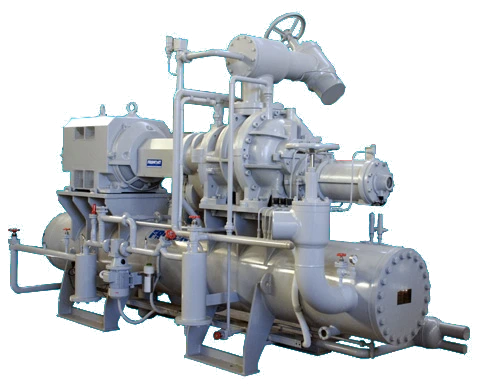
Green chillers · Natural refrigerants
Chillers with ammonia, CO₂ or hydrocarbons: natural refrigerants with no impact on the ozone layer and zero or near-zero GWP.
Explore equipmentAmmonia chillers · R-717
Industrial ammonia chillers: GWP 0, high efficiency and reduced charge.
Explore equipment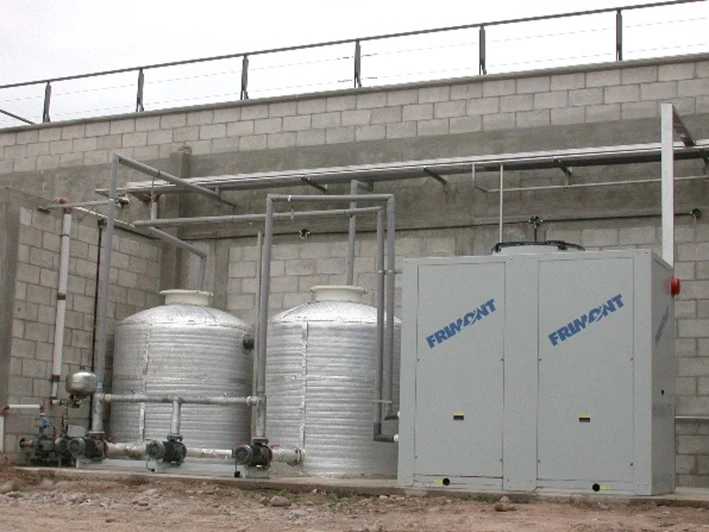
Propane chillers · R-290
Propane chillers: GWP 3, very good efficiency and outside the HFC phase-down, designed for a flammable refrigerant.
Explore equipment