
Cooling towers and evaporative equipment
TEC closed-circuit cooling towers
Cooling towers with a built-in heat exchanger: the process liquid flows through a stainless-steel coil and is cooled without contamination from the air or the basin water.
Also known as shielded or sealed-circuit towers. We build them in FRP and stainless steel, with no galvanized parts.
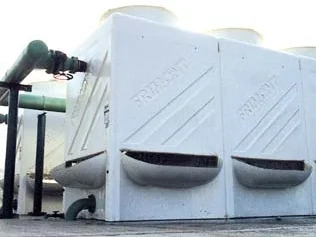
TEC vs. open tower + plate heat exchanger
The most common alternative to a closed tower is an open tower with a plate heat exchanger and a filtration system. It works, but it adds equipment and is delicate: the narrow plate passages foul and scale with tower water, they have to be opened, cleaned and re-gasketed, and the filtration needs its own maintenance.
The TEC does the same job with a single unit and no connections between components. The heavy-wall stainless-steel coil tolerates hard water, accepts chemical and mechanical cleaning and is accessible from the tower itself.
Applications
What it solves.
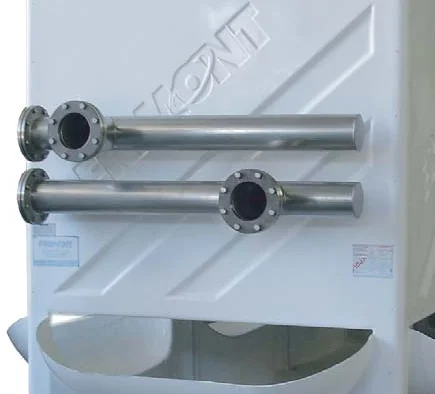
In the TEC, the liquid to be cooled (demineralized water, water with additives, chemicals, oils, juices or musts) flows inside an AISI 304L or 316L stainless-steel coil. Water from the evaporative circuit falls over the coil and the fans' air carries the heat away. The process liquid never touches the air or the basin water, so it picks up no dust, particles or dirt. It is a robust monoblock unit with very low maintenance, designed to work with hard water.
- Cooling of demineralized water and furnace, mold and reactor circuits.
- Cooling of chemicals, oils, juices and musts.
- Condensing for water-cooled chillers in large buildings.
- Replacing an open tower with a plate heat exchanger.
Configurations
A configuration tailored to your application.
Technical selection defines the equipment and its integration with the process.
With its own basin
Complete tower with FRP basin, recirculation pump and a large removable filter that can be cleaned with the unit running.
Without basin
Towers mounted on a concrete basin. The basin is designed to limit stored water and the load on the structure.
CONEV for wineries
Version for wine fermentation control, with two or three circuits to cool several musts at once.
Technical data
Reference values.
TEC vs. open tower with plate heat exchanger
| Open tower + plate heat exchanger + filtration | TEC closed-circuit tower | |
|---|---|---|
| Equipment to maintain | Tower, heat exchanger, filter and pumps for both circuits | A single monoblock unit |
| Weak point | Narrow plate passages that foul and scale; opening, cleaning and re-gasketing | Heavy-wall stainless coil, accessible and cleanable from the tower |
| Filtration | Essential to protect the plates, with its own maintenance | Removable filter in the basin, cleaned while running |
| If the tower water gets dirty | Heat exchanger performance drops and pressure drop rises | Only affects the outside of the coil, which can be washed |
| Connections | Piping, valves and pumps between units | No connections between components |
Qualitative comparison. With very large flows or when the tower already exists, it is worth calculating both alternatives.
Selection
How we define the solution for your process.
We start from what you need to achieve and your facility conditions. We guide you through defining requirements and selecting an appropriate configuration. You do not need to have all this data to start the conversation.
What we evaluate during technical definition
- Liquid and flow
- Which liquid is cooled, how much flows and what pressure drop the circuit allows.
- Temperatures and climate
- Inlet and outlet temperatures, location, altitude and design wet bulb.
- Water, space and installation
- Make-up water quality, available space and maximum weight per piece for lifting.
FAQ
What clients usually ask us
TEC or open tower with a plate heat exchanger?
If the liquid must stay clean and the local water is hard or dusty, the TEC avoids the plate heat exchanger and its filtration, the most delicate and maintenance-heavy parts of that solution. An open tower with a heat exchanger may make sense with very large flows or when the tower already exists; in that case we calculate both alternatives.
How does it differ from a TEV tower?
In the open-circuit TEV, the water to be cooled falls over the fill in contact with the air. In the TEC the liquid flows inside a coil and is never exposed to the air or the basin water.
What materials is it made of?
FRP casing and basin; AISI 304L or 316L stainless-steel coil and headers; stainless-steel structure, supports and bolts. It has no galvanized parts to rust.
Documentation
Technical documentation.
Browse reference brochures for each series. To select equipment, request the configuration and specifications for your project.
Request technical documentationEngineering and integration
Scope is defined with you.
From equipment selection to integration, installation, and commissioning, we agree on what the project needs and how it connects to your facility. Control systems and after-sales service are integral parts of that conversation.
What we can undertakeWithin the same system
Related equipment.
Cooling towers
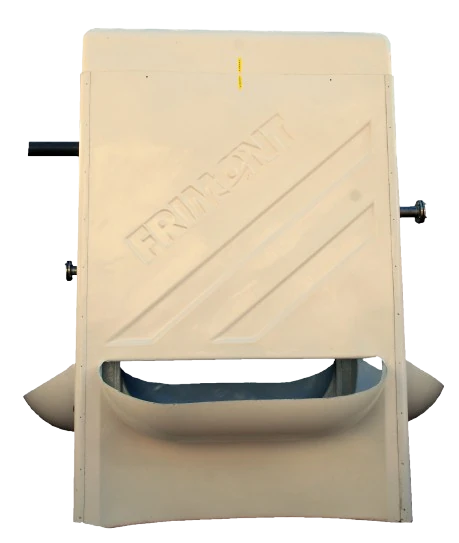
TEV open-circuit water cooling towers, modular and FRP-bodied, and large towers for industrial flows.
Explore equipment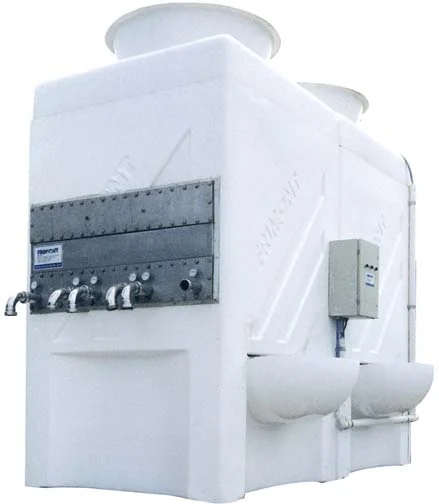
CONEV · Evaporative fermentation controller
Evaporative unit to control the fermentation of red and table wines: it cools two or three musts at once with about 1/8 of the energy of a refrigeration unit.
Explore equipment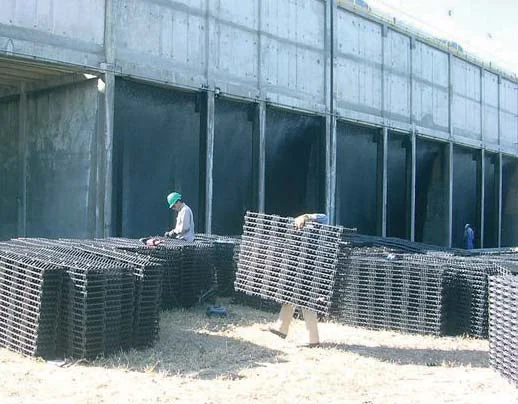
Cooling tower fill and drift eliminators
FRIPACK evaporative fill and FRISEP drift eliminators in injected polypropylene, designed and made by FRIMONT for cooling towers and evaporative condensers working with hard or dirty water.
Explore equipment