
Chillers and liquid chillers
Low-charge chillers · Dry chillers
Chillers with the smallest possible refrigerant charge: cooling reaches the plant through water, glycol, aqueous solutions or pumped CO₂, from +20 °C down to −50 °C.
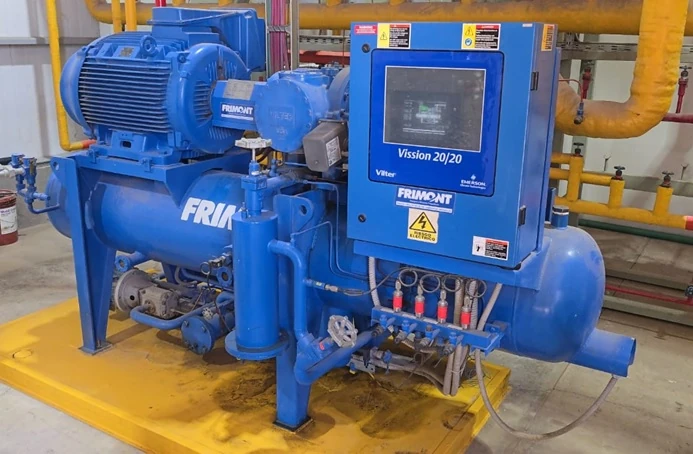
Applications
What it solves.
Beyond choosing refrigerants in line with the recommendations of international organizations, we design systems with the smallest possible charge. The refrigerant stays in a compact dry-expansion chiller and the cooling is distributed by a secondary fluid: water, glycol or aqueous solutions for low and very low temperature, or pumped CO₂. This lets us work from about 20 °C down to −50 °C, depending on what each system needs.
- Processes and cold rooms that need cooling far from the machine room, without taking refrigerant into production areas.
- Ammonia installations looking to reduce charge and simplify safety.
- Freezing and storage at very low temperature with pumped CO₂.
Configurations
A configuration tailored to your application.
Technical selection defines the equipment and its integration with the process.
Dry expansion, minimum charge
The refrigerant works in a compact plate or shell-and-plate heat exchanger with dry expansion. The charge is a fraction of that of a flooded system and stays inside the chiller, with ammonia, CO₂ or another low-GWP refrigerant.
Secondary fluid to the plant
Cooling reaches the consumers through water, glycol or an aqueous solution. Neither the refrigerant nor its piping enters production areas or places where people work.
Pumped CO₂ for very low temperature
In very low temperature systems, liquid CO₂ can replace aqueous solutions: it is pumped to the evaporators, partly evaporates and returns to the chiller, which condenses it. Because it uses latent heat, it moves less flow, with smaller pipes and less pumping energy.
Technical data
Reference values.
Secondary fluids
Indicative fluid temperature ranges; the actual limit depends on concentration and design.
| Fluid | Temperature (approx.) | Advantage | Main precaution |
|---|---|---|---|
| Water | +20 to +4 °C | Simple, inexpensive and very good heat transfer | Not usable below 0 °C |
| Water with glycol (propylene or ethylene glycol) | +5 to −25 °C | Easy to operate; propylene glycol is food-safe | Viscosity rises as it gets colder |
| Salt solutions (potassium formate, calcium chloride) | −20 to −40 °C | Lower viscosity than glycol at low temperature | Corrosion: materials and solution control |
| Pumped CO₂ (R-744) | −30 to −50 °C | Changes phase: less flow and smaller pipes | High pressure, also at standstill |
The fluid is chosen together with the temperature at each consumer, the distances and the pumping energy.
Selection
How we define the solution for your process.
We start from what you need to achieve and your facility conditions. We guide you through defining requirements and selecting an appropriate configuration. You do not need to have all this data to start the conversation.
What we evaluate during technical definition
- Temperature and heat load
- Temperature required at each consumer, capacity and demand variations.
- Distribution
- Distances, number of consumers and pumping energy of the secondary fluid.
- Safety
- Refrigerant charge, chiller location and separation between the machine room and occupied areas.
Documentation
Technical documentation.
Request technical documentation for the configuration required by your process. Tell us about your application and operating conditions to guide the inquiry.
Request technical documentationEngineering and integration
Scope is defined with you.
From equipment selection to integration, installation, and commissioning, we agree on what the project needs and how it connects to your facility. Control systems and after-sales service are integral parts of that conversation.
What we can undertakeWithin the same system
Related equipment.
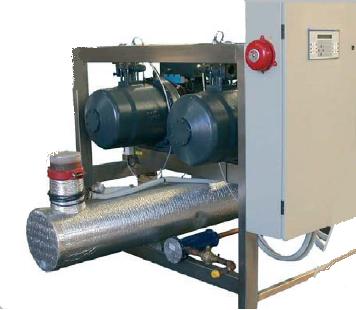
Glycol refrigeration systems
Cold distribution via a secondary fluid loop connecting central generation to facility demands.
Explore equipment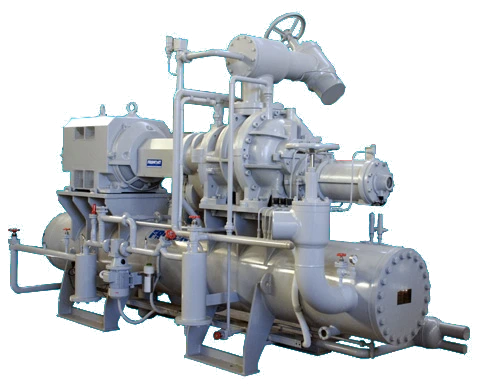
Green chillers · Natural refrigerants
Chillers with ammonia, CO₂ or hydrocarbons: natural refrigerants with no impact on the ozone layer and zero or near-zero GWP.
Explore equipment
Shell & Plate heat exchangers
Welded plates inside a shell for industrial heat exchange.
Explore equipment