
Refrigeration systems and product chilling
Cold rooms with secondary fluid · Dry, indirect systems
Cooling for cold rooms, meat plants and large rooms with no refrigerant inside them: they are cooled and defrosted with water, glycol or aqueous solutions.
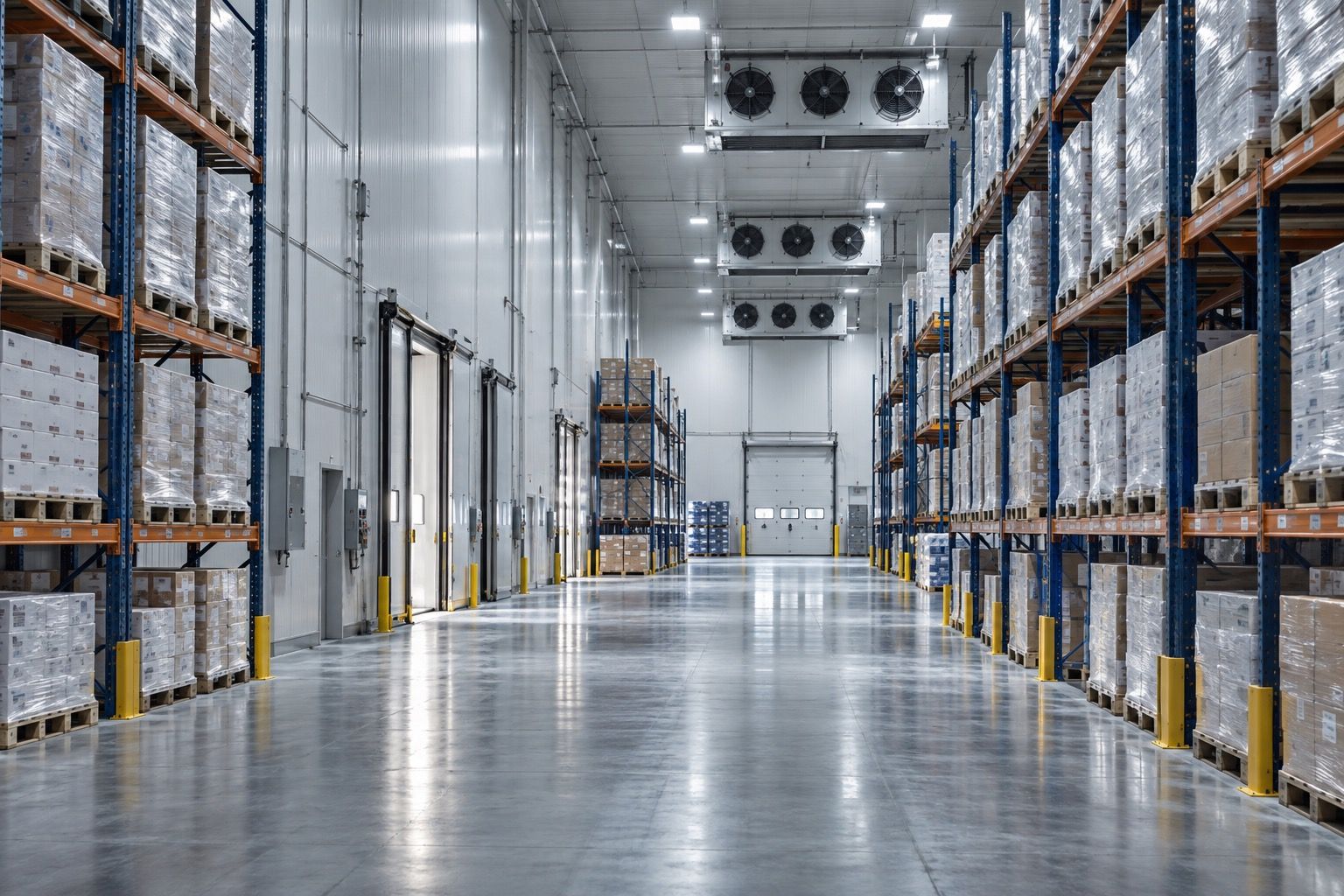
Case in point: a fresh and frozen food distribution center in Santiago, Chile, LEED certified, holds only 300 liters of ammonia; all the cooling, frozen storage included, reaches the rooms through aqueous solutions.
Applications
What it solves.
In industrial refrigeration we can reduce the refrigerant to the smallest possible charge and keep it confined to the machine room. From there, a secondary fluid —water, glycol or an aqueous solution for low temperature— carries the cooling to the air coolers in each cold room or hall, and also the heat to defrost them. The result is safer chilling, storage and processing rooms, with stable temperature and an installation that is simpler to run and to expand.
- Meat processing plants: carcass chilling, cooling and storage of meat, and air-conditioned cutting and packing rooms.
- Logistics centers and cold stores for chilled and frozen goods, with refrigerated anterooms and loading docks.
- Large refrigerated or air-conditioned processing rooms where people work: fruit packing, dairy, poultry and prepared foods.
- Conversion of ammonia or HFC cold rooms to an indirect system, to reduce the charge and take the refrigerant out of the rooms.
Configurations
A configuration tailored to your application.
Technical selection defines the equipment and its integration with the process.
Minimum refrigerant, confined to the machine room
Cooling is produced in a compact, low-charge, dry-expansion chiller with ammonia, CO₂ or another low-GWP refrigerant. The whole charge stays in the machine room, which is designed, ventilated and monitored as the only space with refrigerant.
Rooms without refrigerant
The air coolers in each room work with water-glycol or an aqueous solution. If there is a leak, what comes out is a liquid that can be contained and cleaned up, not a toxic or flammable gas, and safety in the rooms becomes simpler.
Cooling and defrosting with the same fluid
Coils are defrosted by circulating the same fluid, warmed with the heat the system rejects at condensation. No electric heaters or hot gas are needed inside the cold room, and energy that would otherwise be wasted is put to use.
Stable temperature and humidity
The fluid allows each coil to be controlled precisely, room by room, with control valves. The difference between air and coil can be smaller than with direct expansion, which helps keep room humidity and reduce product weight loss; the mass of fluid also dampens load peaks.
Technical data
Reference values.
Fluid by type of room
Indicative values; fluid temperature and concentration are set during the engineering of each installation.
| Room | Room temperature (approx.) | Secondary fluid | Defrost |
|---|---|---|---|
| Air-conditioned processing and cutting rooms | +8 to +14 °C | Water or low-concentration water-glycol | Off-cycle air, no added heat |
| Refrigerated anterooms and loading docks | +2 to +8 °C | Water-glycol | Off-cycle air or warm fluid |
| Carcass chilling, cooling and chilled storage | −1 to +4 °C | Water-glycol (propylene or ethylene glycol) | Warm fluid or off-cycle air |
| Frozen storage and low temperature | −18 to −30 °C | High-concentration glycol or salt solutions (potassium formate) | Warm fluid, heated with recovered heat |
For rooms below about −30 °C, pumped CO₂ is considered; it is no longer an aqueous fluid, and we explain it on the low-charge chillers page.
Selection
How we define the solution for your process.
We start from what you need to achieve and your facility conditions. We guide you through defining requirements and selecting an appropriate configuration. You do not need to have all this data to start the conversation.
What we evaluate during technical definition
- Rooms and temperatures
- Number of cold rooms and halls, temperature and humidity of each, product and loading pattern.
- Fluid and distribution
- Fluid chosen for the lowest temperature, distances, piping, pumping and per-room control.
- Defrost and heat recovery
- Defrost frequency, heat available at condensation and other uses for the recovered heat.
Documentation
Technical documentation.
Request technical documentation for the configuration required by your process. Tell us about your application and operating conditions to guide the inquiry.
Request technical documentationEngineering and integration
Scope is defined with you.
From equipment selection to integration, installation, and commissioning, we agree on what the project needs and how it connects to your facility. Control systems and after-sales service are integral parts of that conversation.
What we can undertakeWithin the same system
Related equipment.
Low-charge chillers · Dry chillers
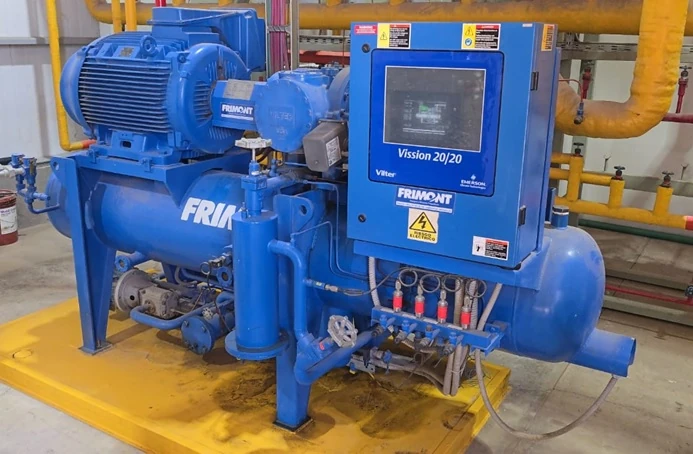
Chillers with the smallest possible refrigerant charge: cooling reaches the plant through water, glycol, aqueous solutions or pumped CO₂, from +20 °C down to −50 °C.
Explore equipment
Industrial evaporators
Air cooling for cold storage rooms and refrigeration processes.
Explore equipment
Glycol refrigeration systems
Cold distribution via a secondary fluid loop connecting central generation to facility demands.
Explore equipment